In 1855, two years before the sepoy uprising that would convulse India from Meerut to Lucknow, the forested hills and plains of what is now Jharkhand witnessed an armed rebellion of staggering scale. The Santhal Hul — "revolution" or "liberation movement" in the Santhali language — erupted on 30 June 1855 when roughly 10,000 Santhals gathered at Bhognadih village under the leadership of brothers Sidhu and Kanhu Murmu, along with their siblings Chand, Bhairav, and sisters Phulo and Jhano. Within weeks, the number of rebels swelled to an estimated 60,000, engulfing a swathe of territory stretching from the Rajmahal Hills to Bhagalpur, Birbhum, and beyond. Karl Marx himself would later describe it as India's first organised "mass revolution."
The Hul was not a spontaneous eruption of anger. It was the culmination of decades of systematic dispossession, debt bondage, and cultural destruction inflicted upon the Santhal people by the British East India Company, its zamindars, and its moneylenders. The rebellion was eventually crushed through martial law and overwhelming military force, with an estimated 15,000 to 20,000 Santhals killed. Yet it forced the British to create a separate administrative district — the Santhal Parganas — and its memory endures as a foundational moment in India's long struggle for freedom.
The Santhals and Their World
The Santhals are among India's largest tribal communities, inhabiting parts of present-day Jharkhand, West Bengal, Bihar, and Odisha. They speak the Santhali language, practice their own religious traditions centred on the worship of nature spirits — chief among them Thakur Bonga, the great spirit — and historically sustained themselves through forest-based agriculture and hunting.
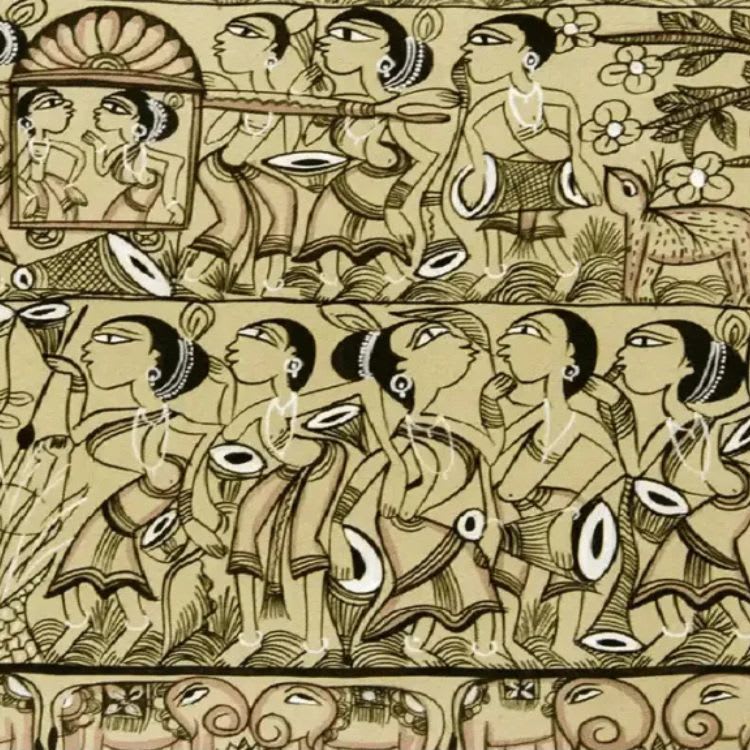
Before British intervention, Santhals lived in scattered communities across the hills of Manbhum, Barabhum, Chhotanagpur, Palamau, and Birbhum. Their social and political structures were organised around village councils and clan networks, with headmen called Manjhis governing local affairs. Land was held communally, and economic life revolved around the barter system rather than cash transactions.
This world began to fracture after the Battle of Plassey in 1757 brought Bengal under East India Company control. The Company's hunger for revenue and agricultural labour would set in motion a chain of events that, within a century, would strip the Santhals of nearly everything they had.
The Trap of Damin-i-Koh
In 1832, the East India Company demarcated a region in the Rajmahal Hills called Damin-i-Koh — "skirts of the hills" — and encouraged settlement for agriculture and revenue generation. When the local Paharia hill tribe declined to cooperate, the Company invited the Santhals to move in, promising land and economic incentives. Their population in the region exploded from roughly 3,000 in 1838 to 82,790 by 1851, and an 1856 report put the number at around 120,000. Company revenue from the area increased twenty-two-fold.
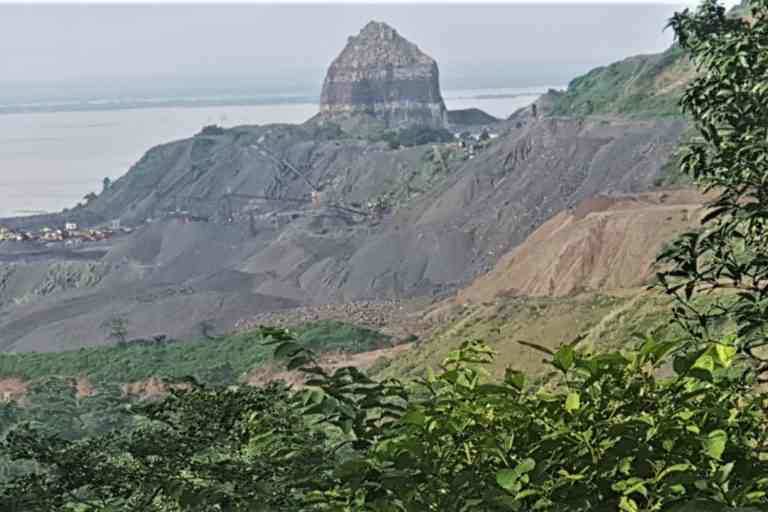
What began as a promise of land quickly became a mechanism of extraction. The Permanent Settlement Act of 1793 had created a class of zamindars who held hereditary rights over land in exchange for fixed revenue payments. Large tracts of Santhal territory were auctioned off to absentee landlords who had no connection to the region. The Santhals found themselves squeezed from every direction:
- Zamindars extracted crippling rents, far exceeding what the land could sustainably yield.
- Moneylenders (mahajans) advanced loans at exorbitant interest rates. When Santhals could not repay, their land was seized and they were forced into bonded labour through systems known as kamioti and harwahi.
- The Company's courts and police consistently ruled in favour of the zamindars and mahajans. Petitions from Santhal leaders were routinely ignored.
- Forced labour was imposed for railway construction between Bhagalpur and Vardhwan, without wages.
- New Forest Policies restricted the Santhals' traditional access to forest resources, destroying a critical part of their subsistence economy.
The introduction of a cash economy was itself devastating. Santhals who had always bartered were now forced to sell produce to diku (outsider) traders at artificially depressed prices. The result was a debt spiral from which there was no legal escape.
The Call of Thakur Bonga
The rebellion crystallised around six siblings of the Murmu clan from Bhognadih village in present-day Sahibganj district, Jharkhand. Sidhu Murmu, born around 1815, and Kanhu Murmu, born around 1820, were the eldest brothers. Alongside them stood Chand and Bhairav, and their sisters Phulo and Jhano.
According to Santhal oral tradition and testimony given during and after the rebellion, Sidhu and Kanhu received visions from Thakur Bonga — the supreme spirit in Santhal cosmology. The spirit appeared in symbolic forms: a flame, a book, white paper, a knife, and a cart wheel, commanding them to drive out the dikus and the British and restore Santhal self-rule. Whatever its origin — genuine spiritual experience or strategic invocation — the claim electrified the Santhals and transcended local rivalries to unite previously fragmented communities.
Secret messages were dispatched across the territories using an indigenous communication system called Dharwak — folded sal (Shorea robusta) branches carried by runners. The system worked with extraordinary efficiency. When the branches arrived in a village, no explanation was needed. The signal was understood: assemble.
The Hul Begins: Bhognadih, 30 June 1855
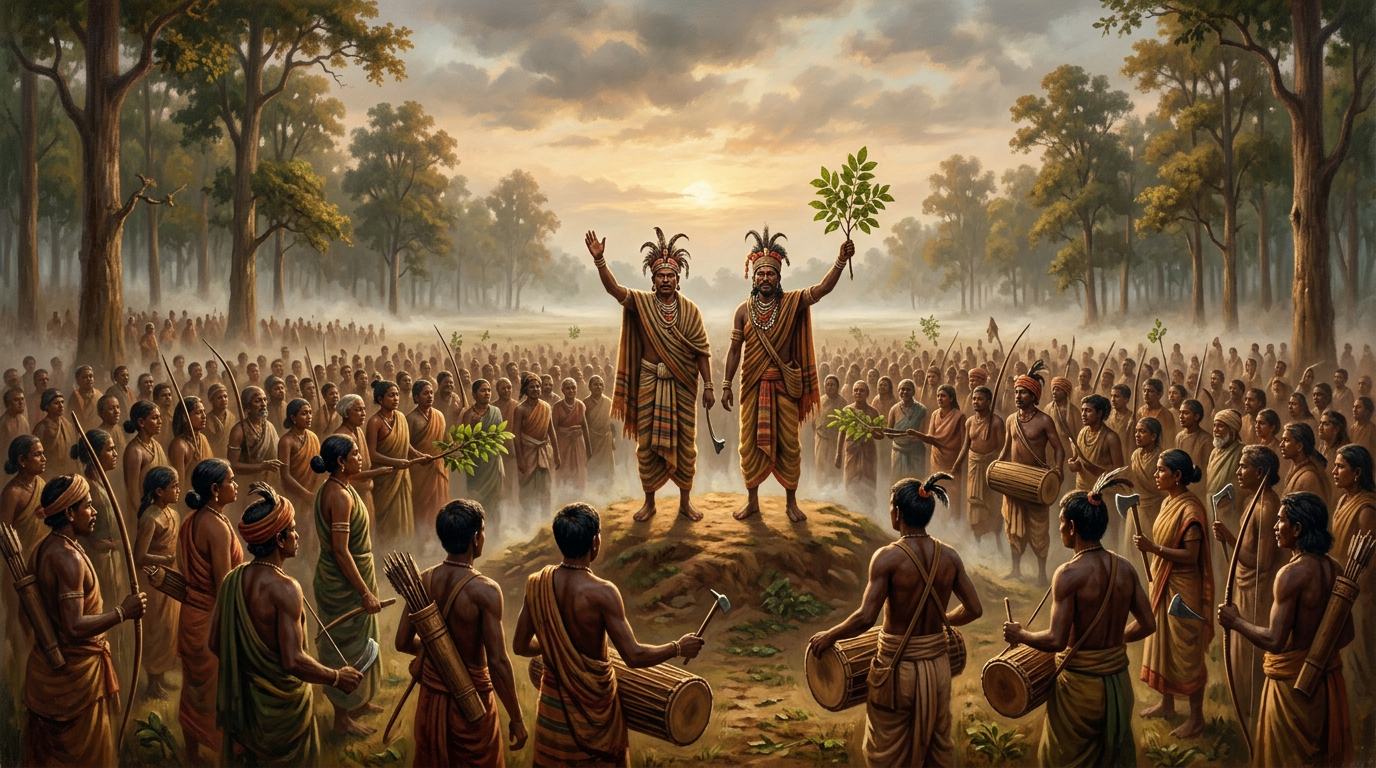
On the night of 30 June 1855, approximately 10,000 Santhals gathered at Bhognadih. Sidhu and Kanhu read out the orders of Thakur Bonga: slaughter the mahajans and darogas, banish the traders and zamindars, sever the connection with the Damin-i-Koh, and fight all who resist — for the bullets of their enemies would be turned to water. Each of the four brothers assumed the title of suba (leader), establishing a rudimentary structure of command.
The rebellion moved with ferocious speed. On 1 July, Santhals killed five mahajans in a local market. On 7 July, when a police daroga named Dutta attempted to arrest the Murmu brothers at a large assembly, Sidhu killed him and had him decapitated — the act that transformed protest into open war.
Over the following days, the Santhals attacked and burned zamindari estates, moneylenders' houses, railway stations, police posts, indigo plantations, and government buildings. They severed road and rail connections to Bhagalpur and advanced in organised squads of roughly 1,000 fighters each.
The Victory at Narayanpur
At the Battle of Narayanpur, Santhal forces routed a company of Paharia Rangers and inflicted a devastating defeat on East India Company troops, killing several Indian officers and 25 sepoys. The Company's weapons malfunctioned due to wet gun caps, and a rumour spread that Sidhu and Kanhu's divine protection had literally turned the bullets to water — exactly as they had prophesied. This victory dramatically boosted morale and drew more fighters into the rebellion.
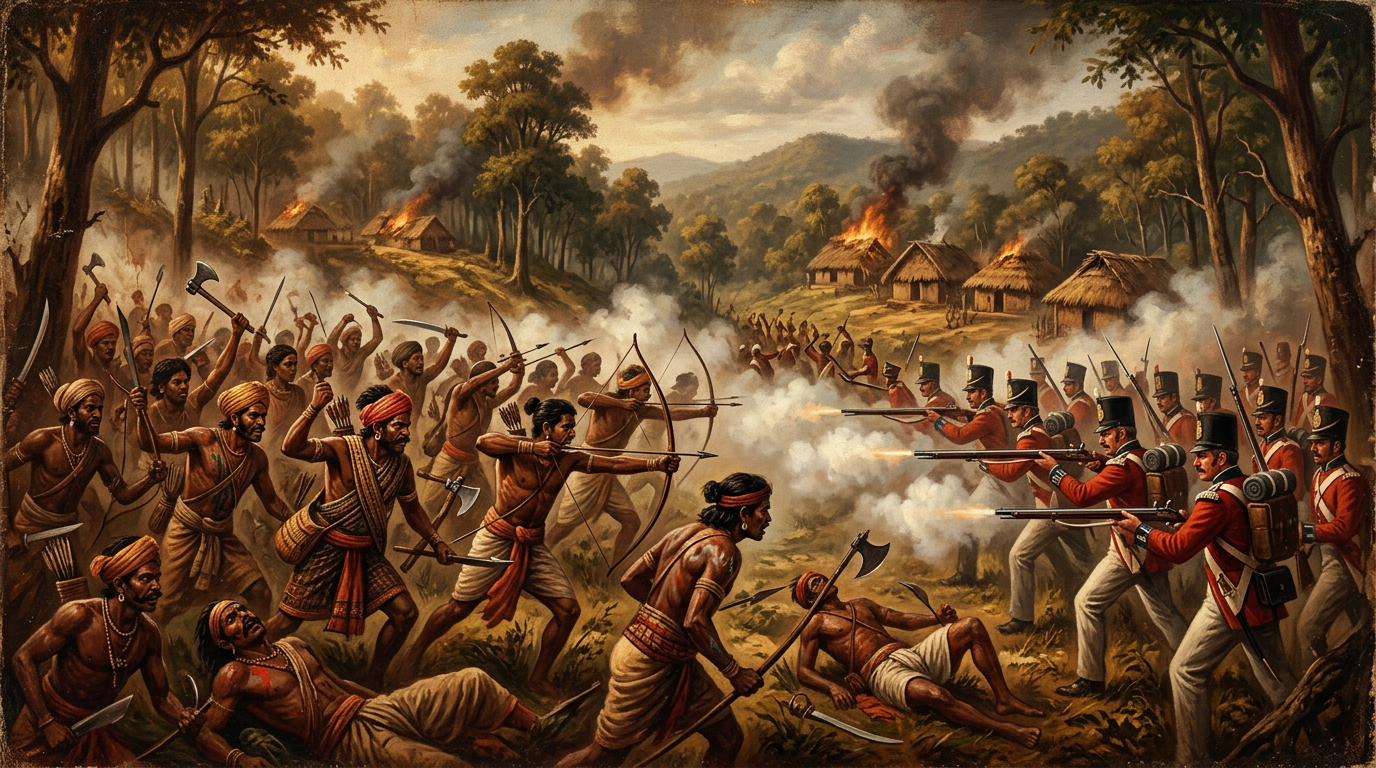
By mid-July, Santhal forces had grown to an estimated 20,000. They had captured and burned the towns of Rampurhat and Pulsa. Sidhu and Kanhu organised their expanding forces with greater structure, granting titles like suba thakur and nazir to subordinate leaders.
The Warrior Sisters: Phulo and Jhano
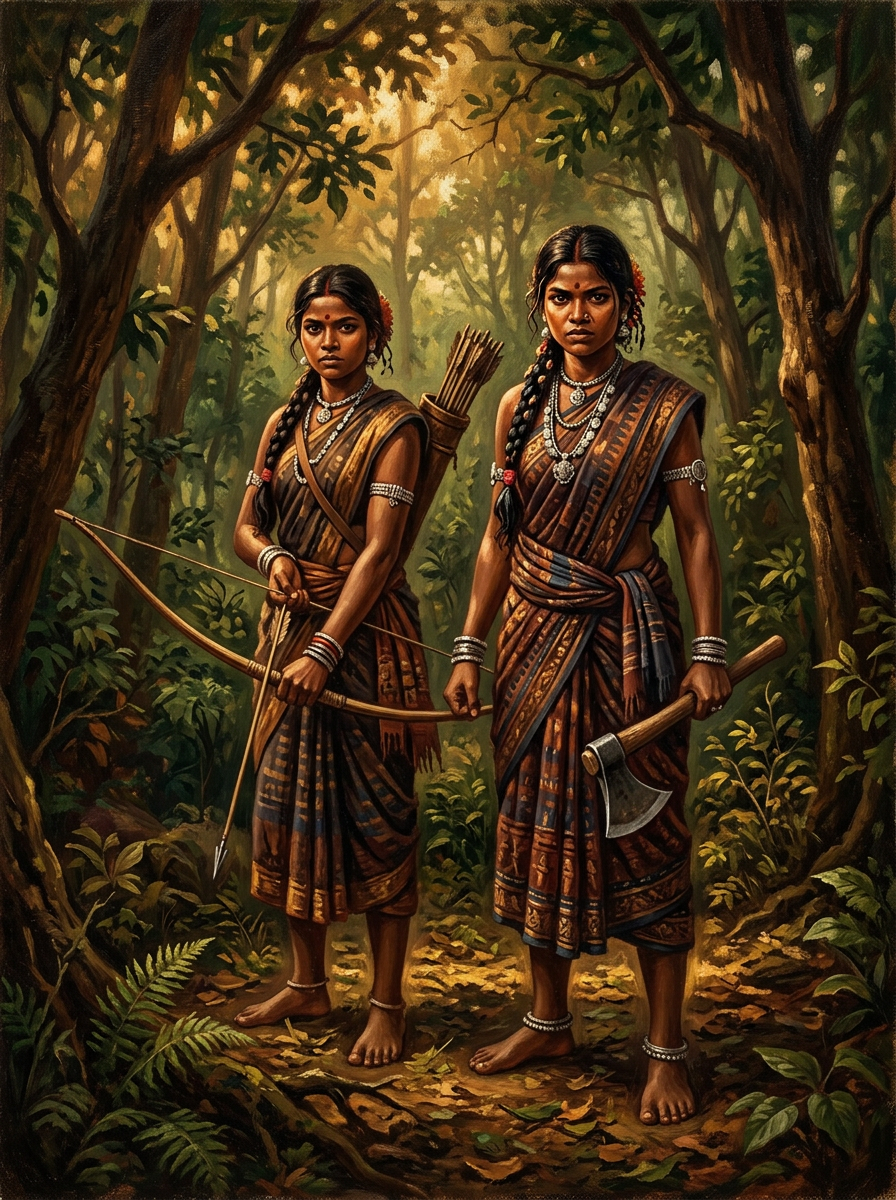
The Murmu sisters, Phulo and Jhano, played roles that shattered contemporary expectations about women's place in warfare. According to oral histories and later accounts, they fought directly in combat, entered enemy lines to gather intelligence, and helped mobilise women across the Rajmahal–Damin-i-Koh region. One account holds that they led an army of roughly 1,000 women. Another oral tradition reports that Phulo and Jhano once entered a tent of British soldiers and killed 21 of them with axes.
Their participation expanded the rebellion's reach and became a lasting part of Santhal memory, preserved in songs, stories, and public commemorations to the present day.
The Empire Strikes Back
The East India Company was initially caught off guard. Local administrators treated the uprising as a minor insurrection, and the Lieutenant Governor refused requests to send 1,500 troops, deeming it unnecessary. This misjudgment cost them dearly.
The first significant British counter-blow came at Maheshpur on 14–15 July, when Commissioner Toogood, with 50 Company troops and 200 soldiers supplied by the Nawab of Murshidabad — along with 30 war elephants — fought 5,000 Santhals. Around 100 rebels were killed, and both Sidhu and Kanhu were wounded. Critically, the Nawab of Murshidabad and other zamindars provided the British with elephants, soldiers, shelter, and provisions throughout the campaign, underscoring the coalition of colonial and feudal interests arrayed against the Santhals.
The Company eventually brought in Major General G.W.A. Lloyd from Dinajpur with five regiments of infantry, Hill Rangers, European troops, and cavalry, in addition to zamindari levies. By August, the Santhals were being pushed back into the hills, but they refused to capitulate, shifting instead to guerrilla tactics — hit-and-run raids, ambushes, and rapid dispersal into the forests.
Martial Law and Betrayal
On 10 November 1855, the Governor-General declared martial law across the zone from Bhagalpur to Murshidabad, authorising the immediate execution of any armed Santhals. The orders nominally forbade harm to women and children, but field commanders routinely ignored these distinctions, burning entire villages and punishing civilians alongside rebels.
Sidhu was betrayed — captured in August 1855 by informers and subsequently hanged. Kanhu, Chand, and Bhairav fled into the hills but were captured in early December 1855 by Paharia rangers while disguised as peasants. Martial law was lifted on 3 January 1856.
The toll was catastrophic. Of the estimated 60,000 Santhals who participated, between 15,000 and 20,000 were killed. Scores of villages were razed and thousands displaced. They had fought bows, arrows, axes, and spears against Company troops armed with muskets and cannon.
Key Figures of the Hul
| Figure | Role | Fate |
|---|---|---|
| Sidhu Murmu b. ~1815 |
Primary leader; claimed divine mandate from Thakur Bonga; ran a parallel Santhal government during the rebellion | Betrayed and captured August 1855; hanged |
| Kanhu Murmu b. ~1820 |
Co-leader; led direct attacks on British positions | Captured December 1855 while disguised; executed |
| Chand Murmu | Suba (leader); coordinated mobilisation | Captured alongside Kanhu; killed |
| Bhairav Murmu | Suba; supported coordination of forces | Captured alongside Kanhu; killed |
| Phulo Murmu | Fighter, spy, and mobiliser of women combatants | Killed during the rebellion |
| Jhano Murmu | Fighter and intelligence gatherer alongside Phulo | Killed during the rebellion |
Aftermath and Reforms
The rebellion forced the British to acknowledge that the Santhals could not be taken for granted. The Sonthal Parganas Act (Act 37 of 1855) carved out the Santhal Parganas as a separate non-regulation district covering approximately 5,470 square miles, placed under a Deputy Commissioner at Dumka. The regular police system was abolished within the district, and village headmen were given authority to maintain order.
Two decades later, the Santhal Parganas Tenancy Act of 1876 was enacted to protect tribal land rights and prohibit the transfer of Santhal land to non-tribals. In practice, however, zamindars and indigo planters pushed back successfully, and many of the protections were eroded.
The Hul in the Longer Arc of Resistance
The Santhal Hul preceded the great sepoy uprising of 1857 by exactly two years. Although they were distinct movements — one tribal and agrarian, the other rooted in the sepoy armies and princely courts — they drew from a shared reservoir of grievance against the East India Company's extractive regime. The Hul demonstrated that massive organised resistance to British rule was possible even from communities the colonial administration dismissed as "primitive."
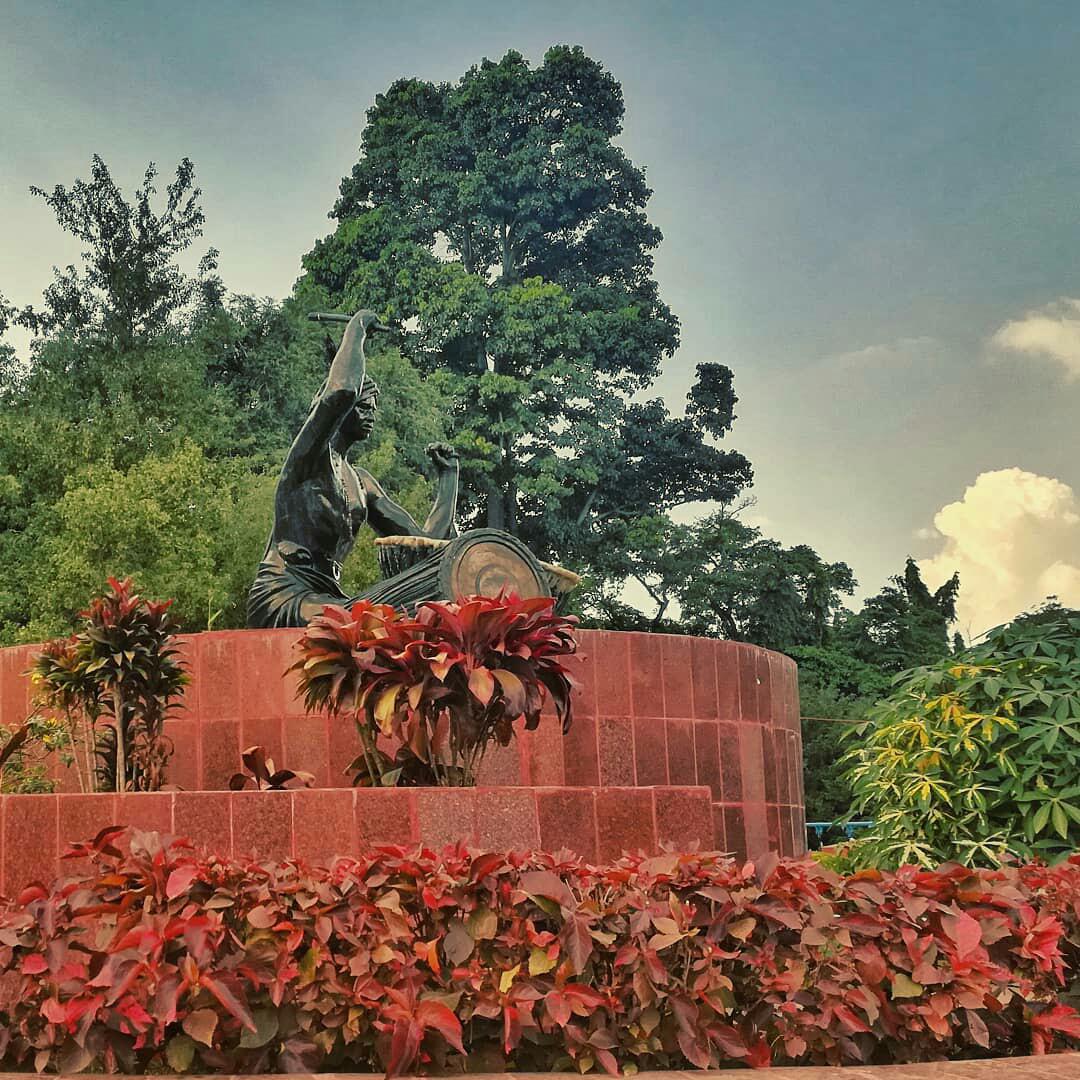
The Hul became a foundational reference point for subsequent tribal uprisings, most notably the Ulgulan (Great Tumult) led by Birsa Munda in 1899–1900. The underlying issue — tribal land rights versus colonial and feudal extraction — remained unresolved through independence and into the present.
The Hul also carries a harder lesson. The Santhals rose against not only the British but against the entire apparatus of extraction: the zamindars, the mahajans, the courts, the police. Some of those intermediaries — including the Nawab of Murshidabad who supplied war elephants — actively aided the suppression. The same pattern of internal fracture that would undermine the 1857 coalition was already visible in 1855, where some Santhals themselves were coerced or paid to betray Sidhu and Kanhu.
Yet the memory endures. Every 30 June, when Santhals gather at Bhognadih to observe Hul Diwas, they recall not merely a defeat but a declaration: that a people's attachment to their land, their gods, and their dignity could not be permanently bought or beaten out of them. The coloniser's most effective weapon was not always the musket — it was the ability to divide. And the Hul, for all its sorrow, proved that the will to resist could survive even that.