
The Alupa Dynasty: Guardians of Coastal Karnataka
The Alupa dynasty, known in Kannada as ಆಳುಪ ರಾಜವಂಶ, stands as one of the most ancient and enduring kingdoms of Karnataka. Dominating the coastal regions of the state, this dynasty's influence stretched far beyond the periods suggested by available monarchial records. Historical evidence indicates that the Alupas may have migrated to the coastal region of Mangalore as early as 300 B.C. Their control extended from Southern Kasaragod to modern-day Udupi, with Mangalore serving as their epicenter. Their rule continued uninterrupted for nearly fifteen centuries, from the early Christian era to the end of the fifteenth century.
Geographical and Cultural Influence
The Alupas governed Tuluva Nadu (South Canara), Haiva Nadu (North Canara), Konkan, the Western Ghats, and northern parts of Kerala at various times. This dynasty and its rulers are referenced in diverse historical sources such as the writings of Ptolemy, the Greek geographer (where they are referred to as Olaikhaura), the Halmidi Inscription of the fifth century, the Guddnapura inscription of Kadamba Ravivarma, and the Chalukya inscriptions of Mangaleesha and Pulikeshi II found at Mahakuta and Aihole (610-642 A.D.). Their realm was possibly known as Alvakheda 6000, with Udayavara (Udyavara) serving as its capital. The dynasty's royal emblem was the double crested fish.
Division and Notable Monarchs
The Alupa dynasty is broadly divided into two periods: the ancient Alupas (up to the mid-tenth century) and the medieval Alupas (up to the end of the fifteenth century). Aluvarasa I, reigning from 650-663 A.D., is the first Alupa king with inscriptional evidence. Key successors include Chitravahana I, Aluvarasa II, Chitravahana II, Ranasagara, Pruthveesagara (Aluvarasa III), Maramma (Aluvarasa IV), Vimaladitya, and Dattalupa. The reigns of Aluvarasa I and Chitravahana I marked a golden period for the Alupas, during which they controlled Mangalapura (Mangalore), Pombucha (Humacha), and Kadamaba Mandala, successfully repelling the Pandyas of Madurai at Mangalapura.
The medieval period of the Alupas is better documented, extending from Kundavarma (950-980 A.D.) to Kulashekhara III and Veerapandya II (1390-1400 A.D.). During this time, their rule was primarily concentrated in Tulu Nadu, with Mangalapura and Barahakanyapura (Barakur) as their capitals. Prominent medieval rulers include Bhujabala Alupendra (Kavi Alupendra), Kulashekhara I (husband of Jakaladevi), Balla Mahadevi, Veera Pandya, and Kulashekhara II. Despite constant conflicts with the Cholas and Hoysalas, they retained their power, eventually becoming subservient to the Vijayanagara Empire and later losing their identity to this dominant power.
Societal Composition
During the Alupa dynasty's rule, several major communities flourished in the region, including the Mogaveeras, Billavas, Nadavas, Jains, Brahmins, and Konkanis. These communities contributed to the cultural and social fabric of the region, which was shaped by the Alupa's prolonged rule.
The Alupa Coinage
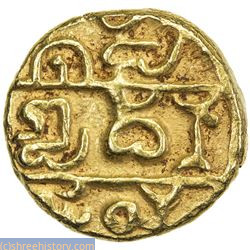
An interesting artifact from the Alupa dynasty is a coin from the 13th century, which offers insight into the economic and cultural exchanges of the time. The coin, an AV pagoda weighing 3.65 grams, features a distinctive design. On the obverse, there are two stylized fish beneath a canopy, flanked by conch shell and lamp symbols. The reverse side bears the legend "Sri Pandya Dhananjaya" in Kannada script. This coin is considered extremely rare and is part of the ex Skanda Collection, Lot 209. It represents a transitional type between the early Kannada and the later Nagari coinage.