When coin from Kashmir says Pakistan must vacate Jeeta Kashmir

    The coin depicted above hails from the early 12th century, a period marked by significant developments in Indian art, religion, and culture. This particular piece, minted between 1123 and 1155 CE, offers a glimpse into the religious symbolism and the skilled craftsmanship that defined the era.

    Obverse: The Deity Ardochsho (Lakshmi) in Lalitasana

    The obverse of the coin features the goddess Ardochsho, identified with Lakshmi, the Hindu goddess of wealth, prosperity, and fortune. She is depicted seated cross-legged in the lalitasana pose, with her right leg folded under her and her left leg hanging down. This posture, often associated with ease and grace, reflects the goddess's benevolent and approachable nature.

    In her right hand, Ardochsho holds a diadem, a symbol of sovereignty and divine authority. In her left hand, she holds a long-stemmed lotus, an enduring symbol of purity, beauty, and spiritual enlightenment in Indian culture. The lotus is not only associated with the goddess Lakshmi but also signifies the ability to rise above worldly troubles, much like the flower that blooms in muddy waters.

    The coin also features an inscription in the Sharada script, an ancient script used in the northwestern regions of the Indian subcontinent. To the left of the goddess, the inscription reads jaya, meaning "victory," and to the right, simha, meaning "lion." These words likely served to invoke divine protection and success for the ruler who issued the coin.

    Reverse: The King Performing a Sacrifice

    The reverse side of the coin portrays a highly stylized king standing and facing forward, engaged in a religious ritual. He is shown sacrificing at an altar, a scene that reflects the deep connection between the monarchy and religious practices in medieval India. The altar to the left underscores the significance of sacrificial rituals, which were believed to ensure the prosperity and stability of the kingdom.

    Another inscription in the Sharada script is present on this side of the coin, reading deva, which means "god" or "divine."

    A Glimpse into Ancient Indian Coinage: The Rudrasena II Coin


    The coin featured above is a fascinating relic from ancient India, specifically from the period of the Western Kshatrapas, a dynasty that ruled parts of western and central India between the 1st and 4th centuries CE. This particular coin, attributed to Rudrasena II, offers a window into the history, culture, and art of the time.

    Obverse: The Portrait of King Rudrasena II

    The obverse of the coin features the head of King Rudrasena II facing right. The Greek influence on Indian coinage is evident in the style of the portrait, which is a hallmark of the Hellenistic impact following Alexander the Great’s incursions into the Indian subcontinent. Around the portrait, there is a blundered Greek legend, a remnant of earlier Indo-Greek coins that had an enduring influence on the region's numismatic traditions. The date, inscribed behind the king's head, marks this coin to the year Saka 136, corresponding to 214 CE in the Gregorian calendar.

    Reverse: Symbolism and Inscriptions

    The reverse side of the coin is rich with symbolism. At its center is a crescented three-arched hill, or chaitya, which was a common motif in Indian art, representing a place of worship or a sacred site. Below the hill flows a river, likely symbolizing the spiritual or life-giving nature of water in Indian culture. To the left of the hill is a crescent moon, while the sun is depicted to the right, together symbolizing the cosmic order and the eternal cycle of day and night.

    Encircling these symbols is an inscription in the Brahmi script, reading: "Rajno Mahakshatrapasa Rudrasihaputrasa Rajno Mahakshatrapasa Rudrasenasa." This translates to "King and Great Satrap Rudrasena, son of Rudrasiha, King and Great Satrap." This inscription not only identifies the ruler but also honors his lineage, highlighting the importance of dynastic heritage.

    Historical Context

    Rudrasena II was a ruler of the Western Kshatrapas, a dynasty that was originally established by the Indo-Scythians and later became one of the most prominent powers in western India. The Western Kshatrapas were known for their unique coinage, which often featured bilingual inscriptions in Greek and Brahmi, as seen in earlier examples, reflecting their interaction with different cultures and peoples.

    The date on the coin, Saka 136 (214 CE), places it during a time of significant political and cultural activity in India. The Western Kshatrapas were contemporaneous with the Kushans to the north and the Satavahanas to the south, both of which were powerful empires. The Kshatrapas maintained their influence through strategic alliances, military strength, and control of important trade routes that connected India with Central Asia and the Roman Empire.

    Artistic and Numismatic Significance

    This coin is particularly notable for its well-preserved portrait of Rudrasena II, which is of significant artistic merit. The clear depiction of the king’s features, along with the detailed symbols on the reverse, make it an exemplary piece of ancient Indian numismatics. The inscription, which is both legible and informative, adds to the coin's historical value, providing insights into the era's language, titles, and religious symbolism.

    The Western Kshatrapas were a dynasty that ruled over the western and central parts of India from the 1st to the 4th century CE. During their reign, they issued a variety of coins that were inscribed in both Sanskrit and Greek languages. These coins provide valuable insights into the cultural and linguistic influences of the time, as well as the trade and diplomatic relations between India and the Greco-Roman world. This article will explore the significance of Western Kshatrapas coins in both Sanskrit and Greek, shedding light on their historical and numismatic importance.

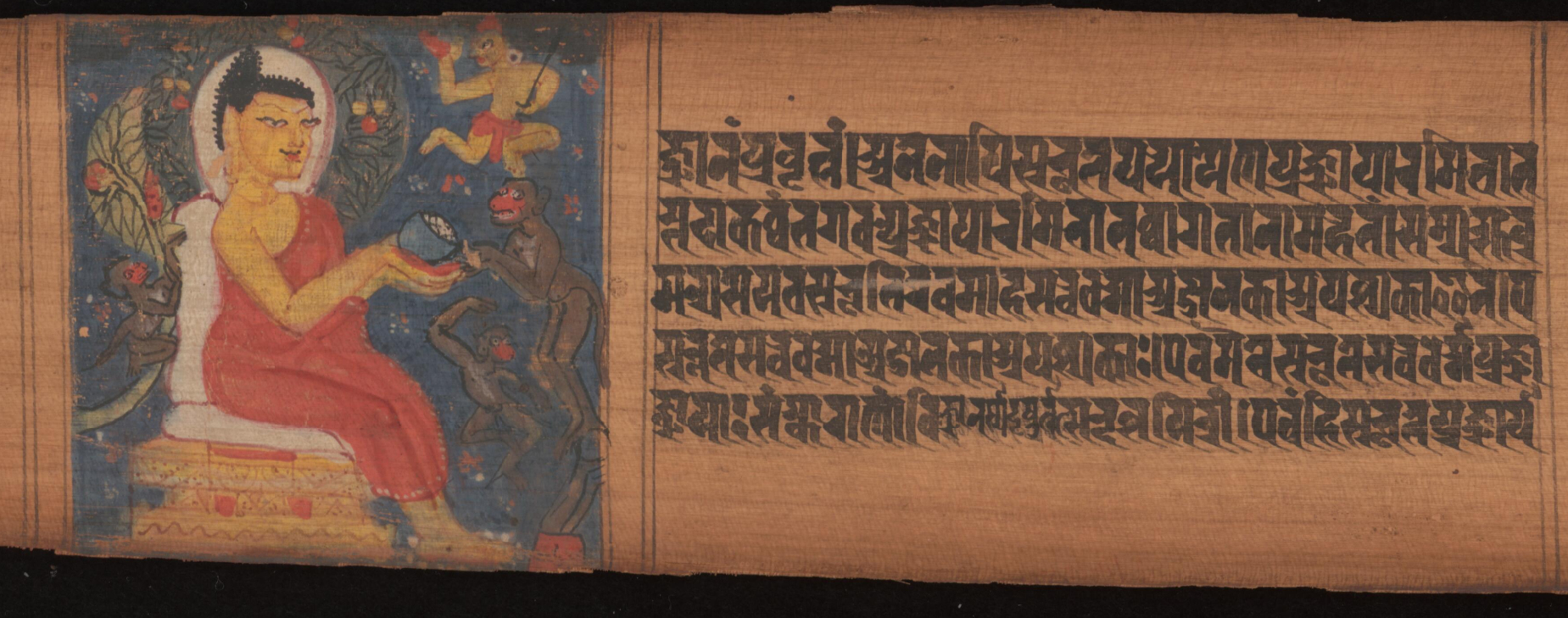
    World's oldest illustrated manuscript is from South India!

    What you are seeing below is world's oldest illustrated manuscript stolen by the British from South India.  Currently University of Cambridge is reported to have this manuscript along with other manuscripts. 

    The manuscript has beautiful illustrations done as you can see.


    Literary and Cultural Significance

    The Aṣṭasāhasrikā Prajñāpāramitā is part of the early Prajñāpāramitā literature, which later expanded into much larger scriptures such as the 'Perfection of Wisdom in One Hundred Thousand Lines' (Śatasāhasrikāprajñāpāramitā) between the second and fourth centuries CE. This text played a crucial role in the Buddhist cult of the book, particularly within Newar Buddhism, emphasizing the veneration of sacred scriptures.

    The Manuscript's Physical Description

    The manuscript in question belongs to the Pāla tradition of illuminated manuscripts, written in the ornamental Pāla script. Originally, it comprised six illuminated folios, each adorned with three miniatures. Unfortunately, the first folio is missing and has been replaced by a later palm-leaf folio without miniatures and in a different script.

    Dating and Authorship

    The dating of the manuscript is controversial. The colophon mentions that it was copied in the fifth regnal year of a Pāla king named Mahīpāla. There were two Pāla kings by this name, and without further specification, the date could be around 985 CE or after 1070 CE. Given that Mahīpāla II likely reigned for only three years, the earlier date is considered more probable.

    The donor of this manuscript, a woman named Lāḍokā, is also mentioned in the colophon, highlighting the role of patrons in the preservation and dissemination of Buddhist texts.

    Artistic and Religious Significance

    The manuscript is protected by two exquisitely painted wooden covers, which bear traces of materials used during worship rites. These covers not only serve a protective function but also signify the manuscript's sacred status and its use in religious rituals.

    The Mahabharata, one of the greatest epics of ancient India, is a text of immense cultural and historical significance. Recent scholarly discussions have brought to light evidence suggesting that the epic, with its voluminous content, dates back to as early as 532 CE. This article delves into the historical and textual evidence supporting the antiquity of the Mahabharata, specifically focusing on its composition and the number of shlokas it contained during that period.

    Evidence from Historical Texts

    A significant reference is found in the works of scholars who have analyzed the Mahabharata's structure and content over the centuries. Notably, the landgrant of A.D. 532/33, which characterizes the Mahabharata as a compilation containing 100,000 shlokas (slokasahasrani satamiti), is a crucial piece of evidence. This indicates that even in the 6th century CE, the Mahabharata was recognized for its extensive composition .

    Textual Analysis and Scholarly Insights

    The article from the Journal of the American Oriental Society provides a detailed examination of the Mahabharata's parvan list, highlighting the complexity and the evolution of its content. The discussion includes the following points:

    1. Origination of Parvan List: At the time of the origination of the parvan list, certain parvans (books or sections) were considered major, while others were supplementary. The confusion around the exact size and subjects of these parvans indicates an ongoing process of textual consolidation .

    2. Doctrinal Passages: The incorporation of the śāntiparvan and khilas into the epic suggests an early acceptance of these sections as part of the Mahabharata. The text also mentions the anuśāsanaparvan, another significant parvan, indicating its established role within the epic's narrative structure .

    3. Interpolation and Later Additions: Scholars such as Winternitz and Bühler have identified specific sections of the Mahabharata, such as Book XII and the virāṭaparvan, as later interpolations. These sections, although seen as later additions, bear the mark of earlier narratives and traditions, reflecting the epic's dynamic evolution .

    4. Strategic Narratives: The epic's strategic elements, particularly in the virāṭaparvan, underscore its intricate storytelling. The manipulation of parvan names and the inclusion of major and minor parvans reflect the epic's complexity and the efforts to maintain narrative coherence over centuries .

    Implications of the Evidence

    The historical and textual evidence suggests that the Mahabharata, in its grand scale of 100,000 shlokas, was already established by the 6th century CE. This challenges earlier assumptions about the epic's composition and highlights its deep-rooted presence in Indian literary and cultural traditions. The references to specific parvans and the scholarly interpretations underscore the meticulous efforts to preserve and expand the epic, ensuring its transmission through generations.

    Conclusion

    The Mahabharata's antiquity, supported by references to its extensive composition as early as 532 CE, underscores the epic's enduring legacy. The scholarly insights and historical references provide a comprehensive understanding of the Mahabharata's evolution, reflecting its significance in ancient Indian literature. This evidence not only affirms the epic's historical depth but also celebrates its monumental role in shaping the cultural and literary heritage of India.


    References

    1. Journal of the American Oriental Society, Vol. 89, No. 2 (1969), pp. 332-337.
    © 2024 ShreeHistory.com. All Rights Reserved.

    Please publish modules in offcanvas position.