The Arthashastra, attributed to the ancient Indian philosopher and statesman Kautilya (also known as Chanakya), is a comprehensive treatise on statecraft, economic policy, and military strategy. The text is divided into several books, each focusing on different aspects of governance and administration. Here is an overview of the books of the Arthashastra:

    1. Vinayadhikarika: On the Subject of Training

      • This book discusses the education and training required for individuals, especially for those in positions of power. It emphasizes the importance of discipline, ethics, and the development of necessary skills for effective governance.
    2. Adhyakshapracara: Regulations for Overseers

      • This section details the roles and responsibilities of overseers and supervisors. It outlines the regulatory framework that these officials must follow to ensure efficient administration and adherence to policies.
    3. Dharmasthiya: On Justices

      • Focused on the judicial system, this book elaborates on the principles of justice, legal procedures, and the role of judges. It covers various laws and the methods to resolve disputes fairly and impartially.
    4. Kantakasodhana: Clearing Thorns

      • This book addresses the strategies for dealing with internal threats and conspiracies. It includes methods for identifying and neutralizing enemies within the state, ensuring internal security and stability.
    5. Yogavrtta: Secret Practice

      • The text here delves into covert operations and espionage. It discusses the importance of intelligence gathering and the use of spies to protect the state from both internal and external threats.
    6. Mandalayoni: The Source of the Circle [of Kings]

      • This section explains the concept of the mandala, or the circle of kings, which represents the geopolitical landscape. It provides insights into foreign relations, alliances, and the dynamics of power among neighboring states.
    7. Shadgunya: The Six Measures [of Foreign Policy]

      • The book outlines six fundamental principles of foreign policy: peace, war, neutrality, alliance, double policy, and making peace with one and waging war with another. These measures guide the state's interactions with other entities.
    8. Vyasanadhikarika: On the Subject of Calamities

      • This book discusses various types of calamities, both natural and man-made, that can affect the state. It provides strategies for prevention, mitigation, and management of these crises to maintain stability.
    9. Abhiyasyatkarman: The Work of a King Preparing to March

      • This section focuses on the preparations and logistics necessary for military campaigns. It covers the planning, mobilization, and execution of warfare to ensure successful outcomes.
    10. Samgramika: On War

      • This book elaborates on the art of warfare, including strategies, tactics, and the conduct of soldiers during battle. It provides comprehensive guidelines for achieving victory in conflicts.
    11. Samghavrtta: Practice against Republics

      • This part deals with the state's interactions with republics and democratic institutions. It outlines the strategies to manage or counteract the influence of republics that might pose a threat to the monarchy.
    12. Abaliyasa: On the Weaker [King]

      • This book provides advice on dealing with weaker kings or states. It includes strategies for maintaining dominance, forming alliances, or annexing weaker territories.
    13. Durgalambhopaya: Strategy for Taking a Fortress

      • Focused on siege warfare, this section details the methods for capturing fortified structures. It covers the tactics and technologies used to breach defenses and secure strategic locations.
    14. Aupanisadika: Esoterica

      • This book delves into esoteric and philosophical aspects of governance. It includes teachings that go beyond practical administration, touching upon moral and spiritual guidance for rulers.
    15. Tantrayukti: The Method of the Treatise

      • The final book explains the methodology and framework of the Arthashastra itself. It provides insights into how the treatise is structured and the logical principles underpinning its recommendations.

    The Arthashastra remains a significant work in understanding ancient Indian political thought and administration, offering timeless wisdom on governance and statecraft.

    The Intersection of Sovereign Power and Sacred Law in the Brhadaranyaka Upanishad

    The Brhadaranyaka Upanishad, dating back to the seventh to sixth centuries BCE, provides a profound exploration of the intricate relationship between sovereign power (ksatra) and sacred law (dharma). This ancient text is crucial for understanding how the union of varna (class) and dharma (duty/law) shapes societal and cosmic order.


    I discuss four verses today along with their translations.  This comes very surprising to me that Brahmin Varna considered Kshatriya as superior.  Unlike whatever is taught in British created history lessons on castes, these verses do not mention anything about birth based system that is inherited.  Also note how Brahmin himself considers Kshatriya to be superior and then Vaishya.  


    First let me give the verses. These are verses from 1.4.11 to 1.4.14.


    ब्रह्म व इदमग्र आसीदेकमेव; तदेकं सन्न व्यभवत् । तच्छ्रेयोरूपमत्यसृजत क्षत्रम्, यान्येतानि देवत्रा क्षत्राणि—इन्द्रो वरुणः सोमो रुद्रः पर्जन्यो यमो मृइत्युरीशान इति । तस्मात्क्षत्रात्परं नस्ति; तस्मात्ब्राह्मणः क्षत्रियमधस्तादुपास्ते राजसूये, क्षत्र एव तद्यशो दधाति; सैषा क्षत्रस्य योनिर्यद्ब्रह्म । तस्माद्यद्यपि राजा परमताम् गच्छति ब्रह्मैवान्तत उपनिश्रयति स्वाम् योनिम्; य उ एनं हिनस्ति स्वां स योनिमृच्छति, स पापीयान् भवति, यथा स्रेयांसं हिंसित्वा ॥ ११ ॥

    स नैव व्यभवत्, स विशमसृजत, यान्येतानि देवजातानि गणश आख्यायन्ते—वसवो रुद्रा आदित्या विश्वेदेवा मरुत इति ॥ १२ ॥

    स नैव व्यभवत्, स शौद्रं वर्णमसृजत पूषणम्; इयं वै पूषा, इयं हीदं सर्वं पुष्यति यदिदं किंच ॥ १३ ॥

    स नैव व्यभवत्, तत्छ्रेयोरूपमत्यसृजत धर्मम्; तदेतत् क्षत्रस्य क्षत्रं यद्धर्मः, तस्माद्धर्माद्परं नास्ति; अथो अबलीयान् बलीयांसमाशंसते धर्मेण, यथा राज्ञैवम्; यो वै स धर्मः सत्यं वै तत्, तस्मात् सत्यं वदन्तमाहुः, धर्मं वदतीति, धर्मं वा वदन्तम् सत्यं वदतीति, एतद्ध्येवैतदुभयं भवति ॥ १५ ॥


    Now let me summarize these verses.  

    Creation and Hierarchy of Powers

    In the beginning, the world existed as only brahman, a unified and undeveloped entity. Brahman then created ksatra, a force superior to itself, embodied by the kshatriyas (warriors) among the gods, such as Indra, Varuna, Soma, Rudra, Parjanya, Yama, Mrtyu, and Iśana. Despite ksatra's supremacy, brahman remains the origin or "womb" of ksatra. Thus, any king, regardless of his power, ultimately returns to brahman, emphasizing that harming brahman equates to self-destruction.

    The Creation of Varna

    Brahman continued to evolve, creating the vaisya class, represented by gods grouped as the Vasus, Rudras, Adityas, All-gods, and Maruts. Yet, brahman still did not achieve full development. It then created the sudra class, exemplified by Pūsan. Despite these creations, brahman remained incomplete.

    The Emergence of Dharma

    Finally, brahman created dharma, a force superior to and surpassing itself. In the text, dharma is described as the ksatra of ksatra, the "sovereign power of sovereign power." This denotes the ultimate authority of dharma over ksatra. Therefore, a weaker individual can invoke dharma to demand justice from a stronger one, similar to appealing to a king.

    Political Theology and Supremacy of Dharma

    This passage from the Brhadaranyaka Upanishad elucidates a political theology where ksatra is initially seen as a force greater than brahman. However, this supremacy is negated in two significant ways:

    1. Origin from Brahman: Ksatra originates from brahman, and thus, harming brahman endangers ksatra itself. This relationship underscores that the warrior class (ksatra) is inherently linked to and dependent on the priestly class (brahman).

    2. Supremacy of Dharma: Brahman generates dharma, which stands above ksatra. Dharma, as the ksatra of ksatra, signifies that even the highest sovereign power (kings) is governed by a higher law (dharma). This establishes a foundational principle that religious and moral law (dharma) governs political power (ksatra).

    Union of Varna and Dharma

    The union of varna and dharma in this context underscores a key relationship between religion and politics. The sovereign power of kings is not absolute but is subject to the guiding principles of dharma. This ancient wisdom from the Brhadaranyaka Upanishad highlights the enduring idea that true sovereignty lies in adherence to higher moral and ethical laws, ensuring justice and harmony in society.

    Indus weights are following a decimal system!

    India is often referred to as the mother of the decimal system, as it is believed to be the birthplace of this fundamental mathematical concept. The decimal system, which is based on the number 10, is used worldwide for counting and calculations. In this article, we provide a proof of existence of decimal system close to 4000 years before present! 

    I collected the data about various weights discovered at Indus sites and created a Kaggle dataset.

    I also wrote code to tabulate these weights and draw a histogram.  

    The histogram is shown here. It demonstrates the concept of decimal system was known to Saraswati civilization. This has been wrongly appropriated to Arabs/Jesuit priests by the western historians. 

    Here are some key points to consider:

    1. The unit weight of these ancient artifacts is approximately 27.4 grams. This standard weight serves as a reference point for the rest of the weights found at the site.
    2. Upon further analysis, it becomes evident that the other weights are either decimal multiples or fractions of the standard 27.4-gram weight. This suggests a sophisticated system of measurement and trade in the ancient Indus civilization.
    3. These findings shed light on the advanced level of organization and precision that was present in Indus society. The use of standardized weights indicates a level of economic and commercial activity that was highly developed for its time.

    Overall, the discovery of these non-random weights at the Indus sites provides valuable insights into the ancient civilization's system of measurement and trade. It is a testament to the ingenuity and sophistication of the Indus people, and it continues to fascinate and intrigue archaeologists and historians alike.


    Reference


    Kaggle dataset

    Indus Weights (kaggle.com)

    code used for analysis. 

    https://www.kaggle.com/code/shreep/indusweights/


    Did "Gandhi" become popular only after movie Gandhi?

    The Impact of the Film "Gandhi" on the Popularity of Mahatma Gandhi and Bollywood's Missed Opportunity

    Introduction

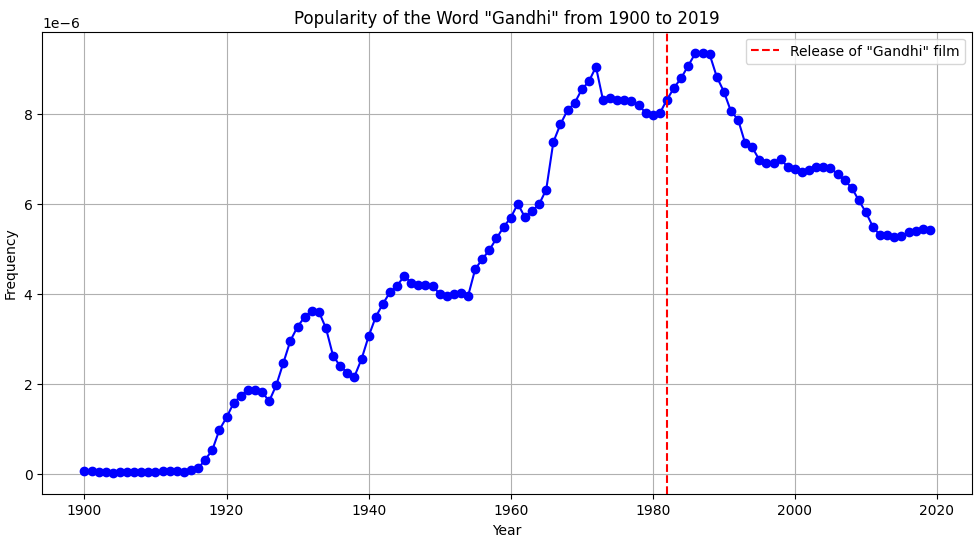
    The word "Gandhi" has been synonymous with peace, non-violence, and the Indian independence movement. The frequency of the word in literature, as depicted in the graph from 1900 to 2019, provides insight into its historical and cultural significance. The graph highlights a notable spike in the popularity of the word "Gandhi" following the release of Richard Attenborough's film "Gandhi" in 1982, showcasing how impactful this cinematic representation was. This article delves into the graph's data, Bollywood's missed opportunity in creating such a pivotal film, and the Indian film industry's focus on less significant historical narratives.

    The Graph: Popularity of the Word "Gandhi" (1900-2019)

    The graph illustrates the frequency of the word "Gandhi" in books from 1900 to 2019. Key observations include:

    • Early 20th Century: The popularity of the word "Gandhi" begins to rise in the 1920s and 1930s, correlating with Mahatma Gandhi's active role in India's independence movement.
    • Mid-20th Century: There is a steady increase in the word's frequency, peaking during the 1940s and 1950s, reflecting Gandhi's continued influence and the global resonance of his philosophy.
    • 1982 Spike: The most significant spike occurs in 1982, coinciding with the release of Richard Attenborough's film "Gandhi." This increase demonstrates the film's global reach and its role in reintroducing Gandhi's legacy to a wider audience.

    Bollywood's Missed Opportunity

    Despite the profound impact of Mahatma Gandhi on India's history, Bollywood, the Indian film industry, has surprisingly not produced a significant film about his life until much later. This absence is perplexing given the industry's prolific output and its focus on historical and biographical films. Several factors contributed to this missed opportunity:

    • Commercial Priorities: Bollywood has often prioritized commercially viable projects over historically significant ones, focusing on genres that guarantee box office success.
    • Political Sensitivities: Films about historical figures like Gandhi can be politically sensitive, and filmmakers may have avoided the topic to steer clear of controversy.
    • Resource Allocation: Significant resources and expertise are required to create a biographical film of Gandhi's magnitude, and Bollywood may have lacked the inclination to invest in such a project.

    Focus on Less Significant Narratives

    While Bollywood hesitated to produce a film on Gandhi, it spent considerable time and resources on narratives surrounding figures like the Ghurid jihadists. These films, often glorifying invaders and conquerors, have been critiqued for misrepresenting Indian history and diverting attention from India's rich cultural heritage. Instead of presenting the story of Bharat and its heroes, Bollywood's fascination with less significant or controversial historical figures has drawn criticism from historians and cultural commentators alike.

    Conclusion

    Richard Attenborough's "Gandhi" not only brought Mahatma Gandhi's story to a global audience but also highlighted Bollywood's shortcomings in representing its own history. The graph showing the spike in the popularity of the word "Gandhi" post-1982 serves as a testament to the film's impact. It underscores the need for the Indian film industry to focus on authentic and significant historical narratives, thereby educating and inspiring future generations about the true essence of Bharat.


    Methodology used: 

    The code used to make this conclusion is open source and shared on Kaggle.com.

    https://www.kaggle.com/code/shreep/gandhimoviefactcheck


    This script does the following:

    1. Fetches the frequency of the word "Gandhi" from Google Ngram Viewer from 1900 to 2019.
    2. Processes the JSON response to extract the relevant data.
    3. Plots the popularity of the word over time.
    4. Highlights the year 1982, which corresponds to the release of the film "Gandhi".


    Claim of Zubair that Gandhi was more popular before the movie is false. 


    The Chahamanas of Ajmer, also known as the Chauhans, were a medieval Indian dynasty that ruled over the region of Ajmer in present-day Rajasthan. Known for their military prowess and patronage of the arts, the Chahamanas played a significant role in shaping the political and cultural landscape of the region. With a history dating back to the 8th century, the Chahamanas of Ajmer left behind a rich legacy that continues to be studied and celebrated today. This article will explore the history, achievements, and impact of the Chahamanas of Ajmer in a neutral and informative manner.

    © 2024 ShreeHistory.com. All Rights Reserved.

    Please publish modules in offcanvas position.