Chahamana of Ajmer, also known as the Chauhan dynasty, was a prominent ruling family in the region of Ajmer during the medieval period. They issued coins with inscriptions of Shri Rama, a revered deity in Hinduism, before the invasion of the region by Ghori, which ultimately led to the destruction of Ajmer. This article will explore the historical significance of these coins and their connection to the religious and political landscape of the time.

    Correcting Historical Narratives: The Legacy of Vigraharaja IV's Coinage

    In the vast tapestry of Indian history, certain periods and artifacts hold a profound significance that goes beyond their immediate context. One such artifact is the coinage from the reign of Vigraharaja IV of the Chahamanas of Sakambhari, a ruler who reigned around 1150-1164 CE. This coin not only offers a glimpse into the political and cultural milieu of its time but also provides an opportunity to address and correct historical narratives that have often been oversimplified or misrepresented.

    The Coinage of Vigraharaja IV

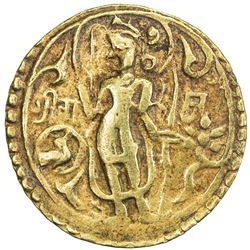
    The coin in question features a striking depiction of Lord Rama on its obverse side. The image of Rama is not merely symbolic; it is laden with cultural and historical significance. Rama is shown holding an arrow in his right hand and a bow in his left, surrounded by trees and vines. Notably, the hamsa bird is depicted to the left, and a lotus to the right, with the legend "Sri Rama" inscribed in Devanagari script.

    The reverse side of the coin bears the Devanagari legend "Srimad Vigraharaja Deva," affirming the ruler’s divine right and connection to the lineage of Lord Rama. This assertion of lineage is not only a statement of religious and cultural identity but also a political claim to legitimacy and continuity.

    Historical Context and Significance

    Vigraharaja IV was succeeded by a line of rulers including Amaragangeya, Prithwiraja II, Someshvara, and ultimately Prithwiraja III. The defeat of Prithwiraja III by Muhammad Ghori in 1192 CE is a well-documented event that led to significant changes in the Indian subcontinent, including the establishment of Islamic rule in parts of India. This period witnessed substantial upheaval and transformation, often marked by narratives of conquest and conflict.

    However, the coinage of Vigraharaja IV offers a different perspective. It underscores the cultural and historical continuity that existed prior to these upheavals. The depiction of Rama,  reflects the 14 years Rama spent in exile seeking the assistance of vanara army, symbolizing loyalty and devotion. This aspect of the coin reinforces the deep-rooted cultural narratives that persisted despite political changes.

    Reclaiming Historical Narratives

    In contemporary discourse, it is crucial to revisit and reclaim such artifacts that offer a more nuanced understanding of history. The connection of the Chahamanas to Lord Rama is a significant assertion of their cultural and religious heritage, one that has often been overshadowed by later historical events.

    By highlighting such connections, we can challenge and correct anomalies in historical narratives. The emphasis on lineage to Shri Rama serves as a reminder of the rich and diverse cultural heritage that predates and coexists with later historical developments. It is a call to acknowledge and celebrate the complexities of Indian history, rather than reducing it to a series of conquests and conflicts.

    Conclusion

    The coinage of Vigraharaja IV is more than just a monetary artifact; it is a testament to the cultural and historical identity of the Chahamanas. It reflects their connection to ancient traditions and their assertion of legitimacy through divine lineage. By bringing such artifacts to light, we can contribute to a more balanced and comprehensive understanding of history, one that honors the diverse and multifaceted heritage of India.


    Coin from VigraharajaVigraharaja Coin

    Kadamba Coin

    The Kadambas of Goa: Unveiling a Legacy of Ancient Trade through Coinage

    The Kadambas of Goa, an influential dynasty in ancient India, offer a remarkable glimpse into the region's rich history and economic prowess through their meticulously crafted coins. Among the notable examples is a gold pagoda from the reign of King Sivachitta, circa 1147/8-1181 AD, which stands out not only for its historical value but also its exquisite craftsmanship and the insights it provides into the era's trade and culture.

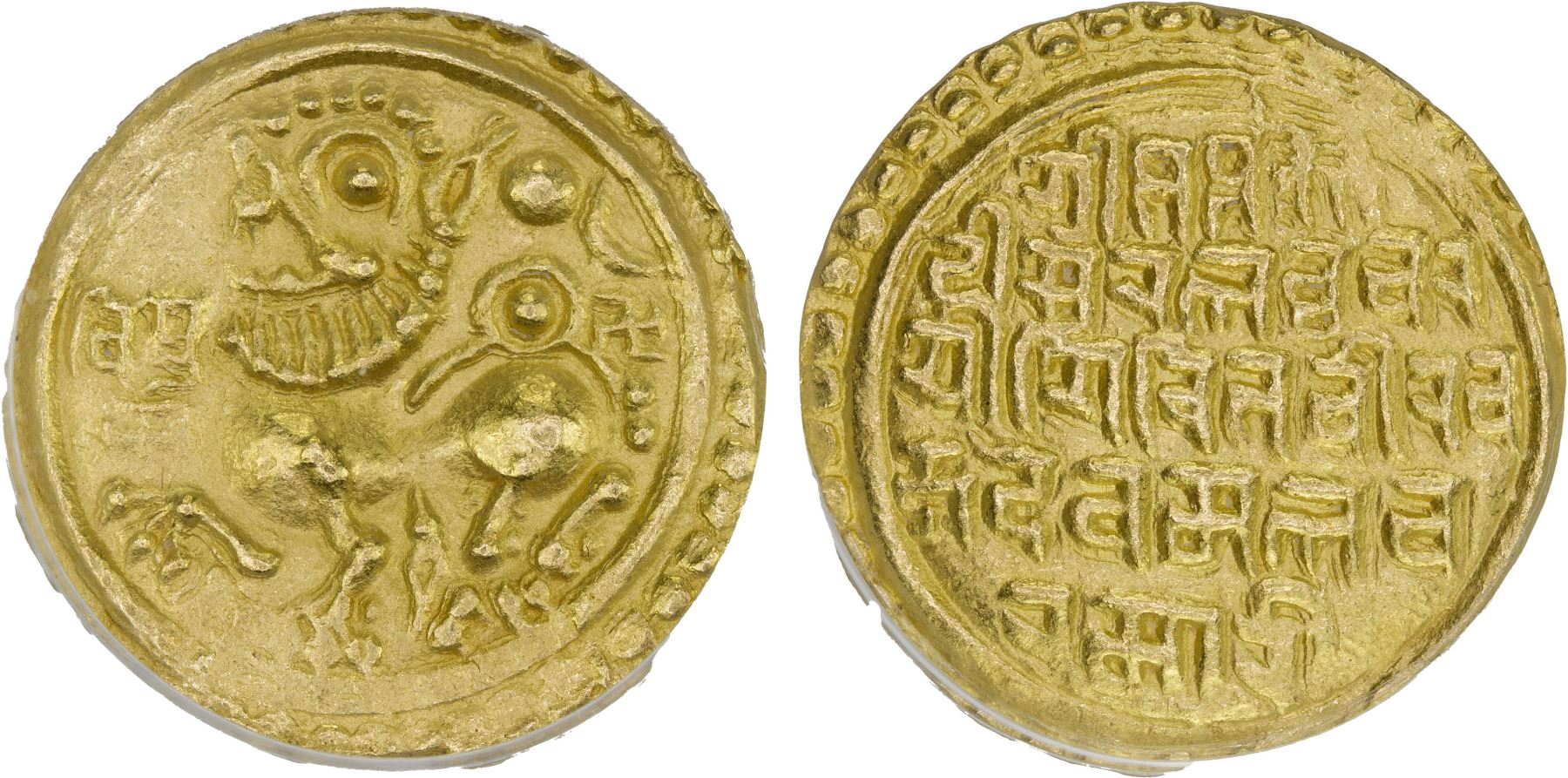
    The Coin's Description and Historical Context This particular gold pagoda, struck in the year named "Chitrabhanu," which corresponds to 1162/3 AD, features a majestic lion standing left, symbolizing strength and sovereignty. The lion raises its right front leg, with symbolic elements such as the sun, crescent, and swastika adorning the right side, and the cyclical date "chitrabha" (a tentative reading) inscribed in Nagari script on the left. The obverse of the coin bears a profound inscription in Sanskrit, extolling King Sivachitta as "Vajradeva, the brave destroyer of the Malavas," and highlighting his divine favor from "Saptakotisvara" (a form of Shiva).

    Significance of the Inscription The inscription is a powerful testament to King Sivachitta’s military prowess and divine endorsement, which were pivotal in legitimizing his rule and reinforcing the socio-political order. Such inscriptions also serve as valuable resources for historians, offering insights into the religious and cultural dynamics of the period.

    Implications for Trade Coins like this gold pagoda not only facilitated trade by providing a stable and trusted medium of exchange but also acted as tools of propaganda and legitimacy for the ruling class. The high-quality gold used in the coin and the intricate details of the strike suggest a flourishing economic climate under the Kadambas, with extensive trade networks that possibly extended beyond the Indian subcontinent.

    Conclusion The coin from the Kadambas of Goa is more than just a medium of economic exchange; it is a cultural artifact that narrates the story of a dynasty that skillfully navigated the complexities of governance, trade, and cultural identity. As we delve deeper into such artifacts, we uncover layers of human endeavor and ingenuity that have shaped the historical landscape of regions like Goa.

    This comprehensive approach to understanding the coin not only highlights its historical and aesthetic value but also underscores the interconnectedness of commerce, culture, and governance in the ancient world.

    Udupi Coin!

    The Alupa Dynasty: Guardians of Coastal Karnataka

    The Alupa dynasty, known in Kannada as ಆಳುಪ ರಾಜವಂಶ, stands as one of the most ancient and enduring kingdoms of Karnataka. Dominating the coastal regions of the state, this dynasty's influence stretched far beyond the periods suggested by available monarchial records. Historical evidence indicates that the Alupas may have migrated to the coastal region of Mangalore as early as 300 B.C. Their control extended from Southern Kasaragod to modern-day Udupi, with Mangalore serving as their epicenter. Their rule continued uninterrupted for nearly fifteen centuries, from the early Christian era to the end of the fifteenth century.

    Geographical and Cultural Influence

    The Alupas governed Tuluva Nadu (South Canara), Haiva Nadu (North Canara), Konkan, the Western Ghats, and northern parts of Kerala at various times. This dynasty and its rulers are referenced in diverse historical sources such as the writings of Ptolemy, the Greek geographer (where they are referred to as Olaikhaura), the Halmidi Inscription of the fifth century, the Guddnapura inscription of Kadamba Ravivarma, and the Chalukya inscriptions of Mangaleesha and Pulikeshi II found at Mahakuta and Aihole (610-642 A.D.). Their realm was possibly known as Alvakheda 6000, with Udayavara (Udyavara) serving as its capital. The dynasty's royal emblem was the double crested fish.

    Division and Notable Monarchs

    The Alupa dynasty is broadly divided into two periods: the ancient Alupas (up to the mid-tenth century) and the medieval Alupas (up to the end of the fifteenth century). Aluvarasa I, reigning from 650-663 A.D., is the first Alupa king with inscriptional evidence. Key successors include Chitravahana I, Aluvarasa II, Chitravahana II, Ranasagara, Pruthveesagara (Aluvarasa III), Maramma (Aluvarasa IV), Vimaladitya, and Dattalupa. The reigns of Aluvarasa I and Chitravahana I marked a golden period for the Alupas, during which they controlled Mangalapura (Mangalore), Pombucha (Humacha), and Kadamaba Mandala, successfully repelling the Pandyas of Madurai at Mangalapura.

    The medieval period of the Alupas is better documented, extending from Kundavarma (950-980 A.D.) to Kulashekhara III and Veerapandya II (1390-1400 A.D.). During this time, their rule was primarily concentrated in Tulu Nadu, with Mangalapura and Barahakanyapura (Barakur) as their capitals. Prominent medieval rulers include Bhujabala Alupendra (Kavi Alupendra), Kulashekhara I (husband of Jakaladevi), Balla Mahadevi, Veera Pandya, and Kulashekhara II. Despite constant conflicts with the Cholas and Hoysalas, they retained their power, eventually becoming subservient to the Vijayanagara Empire and later losing their identity to this dominant power.

    Societal Composition

    During the Alupa dynasty's rule, several major communities flourished in the region, including the Mogaveeras, Billavas, Nadavas, Jains, Brahmins, and Konkanis. These communities contributed to the cultural and social fabric of the region, which was shaped by the Alupa's prolonged rule.

    The Alupa Coinage

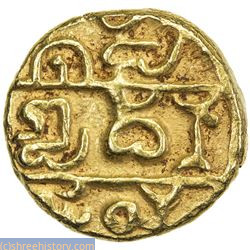
    An interesting artifact from the Alupa dynasty is a coin from the 13th century, which offers insight into the economic and cultural exchanges of the time. The coin, an AV pagoda weighing 3.65 grams, features a distinctive design. On the obverse, there are two stylized fish beneath a canopy, flanked by conch shell and lamp symbols. The reverse side bears the legend "Sri Pandya Dhananjaya" in Kannada script. This coin is considered extremely rare and is part of the ex Skanda Collection, Lot 209. It represents a transitional type between the early Kannada and the later Nagari coinage.

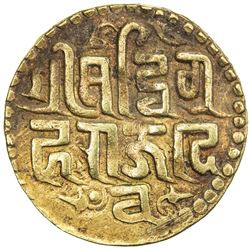
    The Alupa coins of Udupi are a series of ancient coins that were minted by the Alupa dynasty, a ruling family in the region of Udupi in present-day Karnataka, India. These coins are known for their unique designs and historical significance, providing valuable insights into the economic and cultural landscape of the region during the Alupa dynasty's reign. The Alupa coins of Udupi have attracted the interest of numismatists and historians alike, shedding light on the rich heritage of the area. This article will explore the history and significance of these coins, offering a comprehensive look at their role in shaping the region's past.

    © 2024 ShreeHistory.com. All Rights Reserved.

    Please publish modules in offcanvas position.